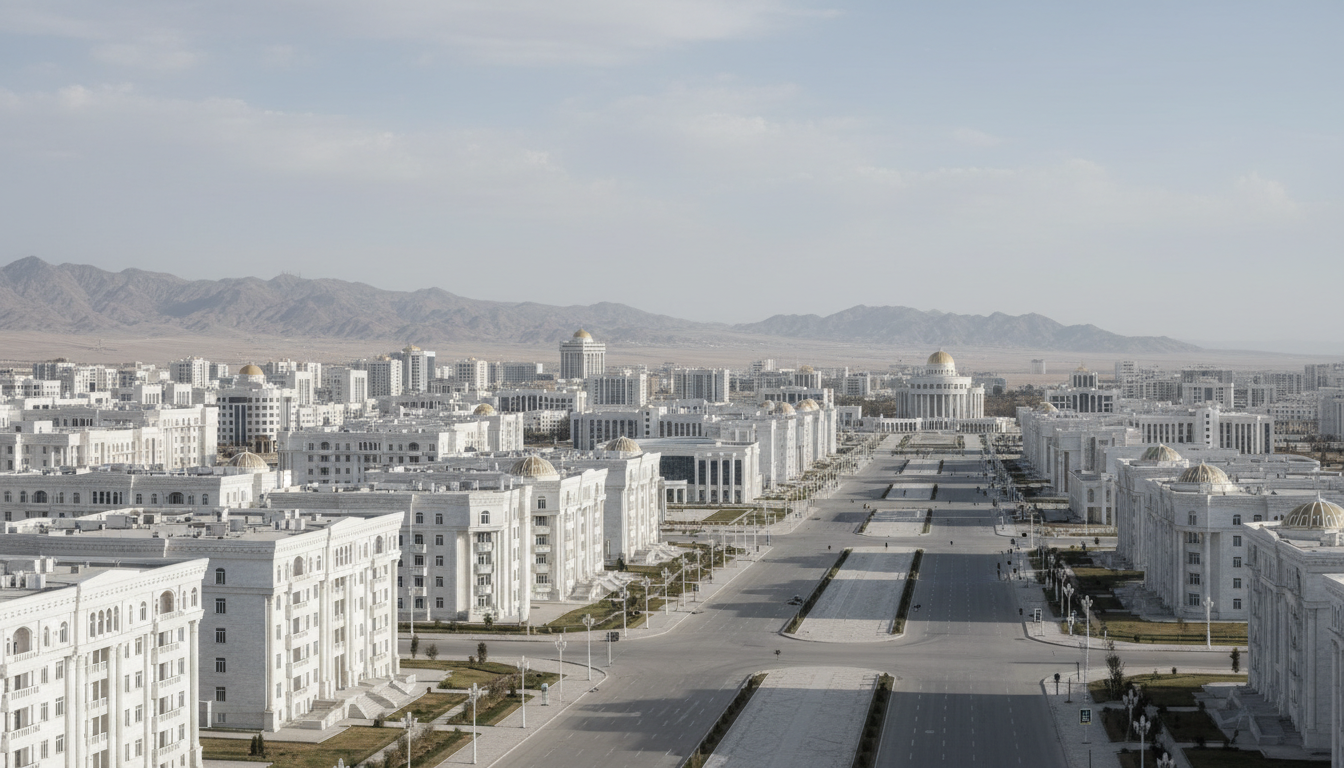
Ashgabat, Turkmenistan’s capital, presents an arresting spectacle: a city almost entirely clad in gleaming white marble, a record-holder for its sheer density of Italian stone. This monochromatic landscape, blinding under the Central Asian sun, projects an image of unshakeable perfection.
Yet, this stunning façade feels less like a living capital and more like a high-budget film set, strangely devoid of the vibrant chaos typically found in national urban centres. It is an aesthetic choice, certainly, but more profoundly, it functions as a state-driven manifesto by a de facto dictatorship.
The regime of President Serdar Berdimuhamedow uses this meticulously constructed "White City" as a powerful visual tool. It aims to project an image of power and stability to the outside world, simultaneously masking the country’s deep isolation and pervasive economic woes.
Such monumental urban transformation has not come cheaply, carrying an estimated price tag exceeding USD 14 billion. This financial titanism is largely fuelled by Turkmenistan’s vast natural gas reserves, often termed 'Blue Gold', ranking as the world’s fourth-largest.
Indeed, the government receives 85 per cent of its revenue from energy exports, primarily to China and Russia, with potential pipelines to Europe also on the agenda. This significant influx of wealth, however, rarely trickles down to the general populace.
Instead, the nation’s considerable earnings are funnelled into an endless succession of vanity projects, continuing a legacy of grandeur from previous regimes. From the world’s largest indoor Ferris wheel to a colossal horse-shaped stadium, the priorities of the state are starkly evident.
The result is a city often described as the 'City of the Dead,' where grand new districts remain eerily empty. Ashgabat’s meticulous perfection is maintained through a rigid system, where only legally registered citizens may inhabit these areas.
Beneath this opulent surface, however, lies a far darker reality for the vast majority of Turkmenistan’s citizens. The nation currently faces a worsening hydrological and humanitarian crisis, its survival dependent on the rapidly retreating Amu Darya River.
While Ashgabat boasts the world record for public fountain pools, flowing day and night, the rural provinces are increasingly parched. Water, a decorative plaything in the capital’s artificial parks, is a disappearing luxury elsewhere.
This stark disparity extends to a deepening food security crisis, a profound irony for a gas-rich nation importing 60 per cent of its food. The average Turkmen family faces a daily struggle against hyperinflation and chronic scarcity, often spending up to 80 per cent of their income on basic groceries.
Indeed, literal 'bread lines' have become a fixture of daily life for countless citizens, who wait for hours outside state-run stores. Often, despite their long vigil, they are turned away empty-handed when subsidised flour or oil stocks deplete. This is the reality beneath the shine.
This marble mirage, while visually striking, underscores a profound disconnect between the ruling regime and its populace. Turkmenistan’s record-breaking façade attempts to project an image of success, masking deep isolation and economic woes from external observers and potential partners.
The global players reliant on Turkmenistan’s energy exports might overlook these internal contradictions for pragmatic reasons. Yet, the persistent struggle for basic necessities at home reveals the ultimate fragility of a governance model divorced from its people’s lived reality.
Ultimately, the true measure of a nation’s strength and stability lies not in its architectural records or the gleam of its marble, but in the well-being and security of its citizens. Ashgabat’s blinding facade serves as a potent reminder of this fundamental truth.