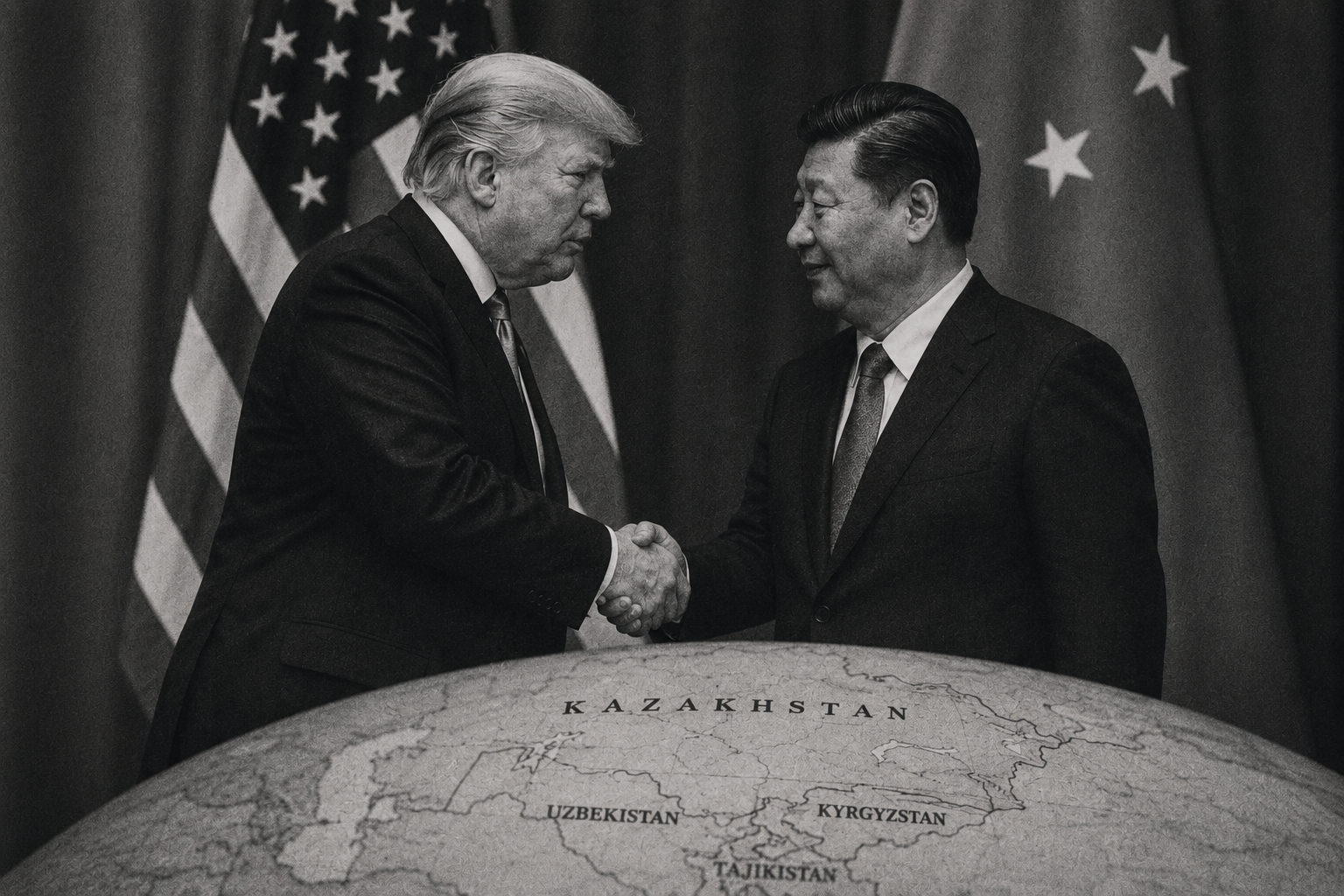
U.S. President Donald Trump arrived in Beijing on Wednesday for the first American state visit to China in nearly a decade, accompanied by a delegation that included Elon Musk, Tim Cook, and Jensen Huang — a combination that said as much about Trump's priorities as any diplomatic communiqué. The two-day summit, focused on trade, Taiwan, the Iran war, rare earths, and artificial intelligence, is the most consequential bilateral meeting of 2026. For Central Asia, it may also be the most consequential meeting of the decade.
The region does not appear in the summit's official agenda. No Central Asian leader is in Beijing. No C5+1 communiqué will be issued. And yet the outcome of the Trump–Xi meeting will directly shape the strategic environment in which Kazakhstan, Uzbekistan, Tajikistan, Kyrgyzstan, and Turkmenistan must operate — and each capital is watching with a calibrated attention that outsiders rarely credit.
The leverage moment
To understand why this summit matters to Central Asia, it helps to trace the arc of the past year. In April 2025, Beijing expanded export restrictions on rare earth elements — materials central to electric vehicles, smartphones, defence systems, and AI hardware — in retaliation for U.S. tariffs. The restrictions sent shockwaves through Western supply chains and refocused global attention on an uncomfortable fact: China controls roughly 70% of rare earth mining and 90% of processing. Finding alternatives became an urgent priority.
Central Asia found itself, almost overnight, at the centre of that search. Kazakhstan reported in April 2025 that geologists had discovered deposits of cerium, lanthanum, neodymium, and yttrium in Karagandy — potentially more than 20 million metric tons, which would rank among the world's largest known reserves. Uzbekistan announced rare earth projects worth $500 million. Tajikistan's President Rahmon reminded anyone who would listen that his country had "very rich, boundless" critical mineral resources.
Washington responded. In November 2025, Trump hosted all five Central Asian leaders at the White House — the first such summit in the C5+1 format. The results were significant: Kazakhstan announced 30 deals worth $17.2 billion and joined the Abraham Accords; Uzbekistan committed to purchasing $100 billion in American goods over ten years. Uzbek President Mirziyoyev called Trump "president of the world" — a formulation that raised eyebrows but reflected the geopolitical temperature of the moment.
"The Central Asians look well-positioned with their large deposits and growing investment in the Middle Corridor. That makes the United States even more of a counterweight as the Central Asians look to preserve their multi-vector foreign policies."
— Joseph Epstein, Yorktown Institute's Turan Research Center, RFE/RL, November 2025
What Astana is watching
For Kazakhstan — the region's largest economy and its most sophisticated diplomatic player — the Beijing summit is being tracked on multiple frequencies simultaneously.
The trade dimension is direct. Kazakhstan exported $3.07 billion in critical minerals to China in 2023 versus $544 million to the United States. The gap reflects decades of geographic and financial logic, not geopolitical preference. If the Trump–Xi summit produces a durable trade truce — extending the October 2025 detente that paused the most aggressive tariff escalation — it stabilises the global commodity environment on which Kazakhstan's export revenues depend. If it produces renewed escalation, volatility in energy and metals markets follows.
President Tokayev has described rare earths as "the new oil" and their development as a "priority task." Kazakhstan's announcement of rare earth deposits in April 2025 was followed by a $1 billion financing programme launched by the country's Development Bank. The question of who processes those minerals — and under what terms — is precisely what the Trump–Xi conversation around supply chain decoupling will shape.
Tengrinews, Kazakhstan's largest English-language portal, covered Trump's arrival in Beijing prominently, noting his personal relationship with Xi and flagging the Iran war as the most unpredictable variable. The Astana Times has positioned Kazakhstan's mineral diplomacy explicitly within the frame of US-China competition, covering Secretary Rubio's engagement with Kazakh counterparts in June 2025 as evidence that Washington is treating the relationship with new seriousness.
What Tashkent is calculating
Uzbekistan's approach to the summit reflects a different calculus. Mirziyoyev's government has pursued economic reform with unusual energy, and the country's engagement with both Washington and Beijing reflects a deliberate strategy of parallel deepening rather than forced choice.
Tashkent participated enthusiastically in the November 2025 White House summit, committing to the $100 billion procurement framework and proposing institutional architecture — a C5+1 permanent secretariat, a Central Asian Investment Partnership Fund, a Special Committee on critical minerals — that would lock in US engagement structurally. At the same time, Uzbekistan has continued to deepen its ties with China through the BRI framework, recognising that Chinese capital and infrastructure financing remain essential to its development model.
Kun.uz, Uzbekistan's leading independent portal, has covered the Trump–Xi summit with notable restraint — factual reporting without editorial positioning. The contrast with state media is instructive: official Uzbek outlets have emphasised the country's balanced relationships, while independent coverage focuses on the economic implications for commodity markets.
"The Central Asian region, economically, politically and geographically, are very close to both China and Russia. This is not a question of choosing political or geopolitical loyalty."
— Sherzod Dzhuraev, Central Asia analyst, Al Jazeera, November 2025
What Dushanbe is hoping for
Tajikistan's position is the most exposed of the five Central Asian states — and the most revealing of the regional dilemma.
President Rahmon was in Beijing last week, meeting Xi just days before Trump's arrival — a sequence that was not coincidental. Tajikistan is the poorest country in the post-Soviet space, heavily indebted to China (approximately 40% of external debt), and dependent on Russian remittances for household income. Its mineral wealth is real but largely undeveloped. The November 2025 White House visit gave Rahmon an opportunity to signal receptivity to American engagement; the meetings with Xi this week reinforce that Dushanbe will not abandon its primary financier.
For Tajikistan, the optimal outcome of the Trump–Xi summit is a stable relationship between the two powers — not a decoupling. Full US-China decoupling would force Dushanbe into an impossible choice between its largest creditor and its most important potential new partner. A managed competition, in which both Washington and Beijing continue to invest in the region, is the scenario that preserves Tajikistan's limited room for manoeuvre.
Asia-Plus, Tajikistan's leading independent English-language outlet, has focused its coverage of the summit on the rare earths dimension and on Rahmon's recent Beijing visit — framing both as evidence that Dushanbe is actively positioning itself as the summit's secondary diplomacy proceeds.
Mongolia's particular attention
Mongolia occupies a unique position: literally landlocked between Russia and China, with no land border with any other country. Its multi-vector "third neighbour" policy — cultivating Japan, South Korea, the US, and European partners as counterweights — has produced its most significant recent expression in ongoing talks about a new trans-Mongolian rail corridor that would bypass Russia.
The Trump–Xi summit is being watched in Ulaanbaatar through the lens of corridor economics. If the summit produces a trade framework that facilitates Chinese export growth through alternative routes, Mongolia's transit value increases. If it produces a managed decoupling that reduces Chinese manufactured export volumes, the corridor's business case weakens. The UB Post has covered the summit with an emphasis on the trade truce implications for Mongolian commodity exports — copper and coal, in particular — both of which flow primarily to China.
The regional calculation
Across the region, the dominant response to the Trump–Xi summit is not anxiety but opportunity — the opportunity to be indispensable to both sides. The multi-vector foreign policies that Central Asian states have pursued since independence were once described as weakness or strategic ambiguity. In the current environment, they look increasingly like sophisticated positioning.
Kazakhstan's Tokayev called the November 2025 White House summit "the beginning of a new era of interaction between the United States and Central Asia." That formulation was carefully chosen. Not a shift — an era of interaction. The language signals openness without exclusivity, engagement without alignment.
The risk in this positioning is real. As CFR analyst Scott Kennedy noted ahead of this week's summit, China enters the Beijing meetings "far more confident than in 2017." A China that feels it has successfully neutralised American pressure is a China with less incentive to compete aggressively for Central Asian partnerships. The leverage that the region has accumulated over the past eighteen months is partly a function of US-China tension. A genuine détente — the least likely but most geopolitically significant summit outcome — would complicate the calculus.
For now, Central Asia is watching Beijing — and finding reasons for cautious optimism in whatever the two leaders decide.