This week delivered three separate but structurally connected stories from Central Asia and the South Caucasus — each involving sanctions, each involving different countries, and each illustrating a different dimension of the same underlying pressure. Taken together, they mark a significant escalation in the EU's effort to close the channels through which Russian military procurement has continued despite four years of Western restrictions.
The common thread is not conspiracy. None of these governments designed their economies to serve Russia's war machine. But geography, economic dependency, and the absence of robust enforcement created conditions that actors with strong incentives — Russian-linked companies, intermediary traders, crypto platforms — have systematically exploited. The bill is now arriving.
Case 1 — Kyrgyzstan: the crackdown that was always coming
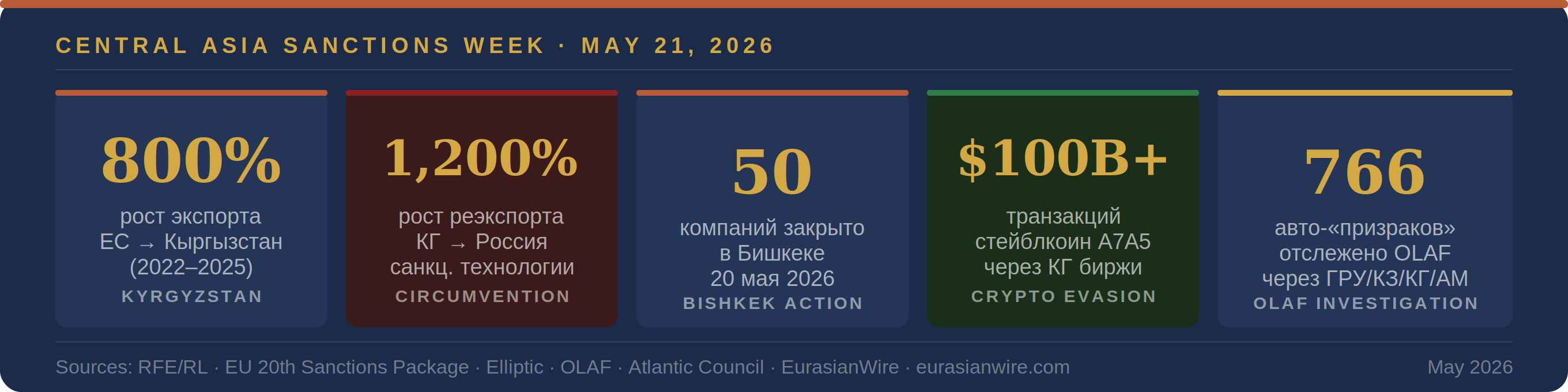
Bishkek moved first and most visibly. The Kyrgyz Justice Ministry announced on Tuesday that 50 companies would be forced to suspend operations following notifications from the United States and the United Kingdom about suspicious activity linked to sanctions circumvention. Deputy Prime Minister Daniyar Amangeldiev confirmed the action to the state news agency Kabar, noting that of 51 flagged companies, 50 would be immediately suspended pending judicial review.
The move comes directly in the wake of the European Union's 20th sanctions package, adopted on May 14 — last Wednesday. That package designated Kyrgyzstan as a "country of concern" for circumvention and, for the first time, activated the EU's anti-circumvention instrument — a tool introduced in 2023 as a theoretical "last resort" and now applied for the first time in practice. The package imposed export bans on two specific categories of goods to Kyrgyzstan: computer-controlled CNC machines used for precision manufacturing, and radio communications equipment. Both categories have direct military applications and both had recorded extraordinary export spikes.
The EU data underpinning the decision was striking. Exports of controlled dual-use technologies from the EU to Kyrgyzstan rose nearly 800 percent between 2022 and 2025 compared to pre-invasion levels. Kyrgyz re-exports of sanctioned technologies to Russia grew by 1,200 percent over the same period. There was no corresponding growth in domestic Kyrgyz manufacturing that could explain the import surge — the goods were passing through.
The financial channel has been equally significant. By January 2026, the A7A5 stablecoin — a ruble-backed digital asset designed to route Russian capital around dollar-denominated systems — had processed over $100 billion in cumulative transactions. Trading was concentrated on two Kyrgyz crypto exchanges, Grinex and Meer. The EU's 20th package added TengriCoin, the Bishkek-based operator, to its blacklist; the US Treasury and UK authorities had already sanctioned the platform and its founders in 2025. RFE/RL's Kyrgyz service estimated A7A5 transactions at $79 billion; other sources put the Grinex figure above $100 billion by early 2026.
"If individuals or private companies profit from bypassing sanctions and the EU then sanctions the country, we will all bear the consequences. It's easy to fall under sanctions, but very difficult to recover."
— Marat Musuraliev, Kyrgyz economist, RFE/RL, February 2026
Bishkek's response to Western pressure has been cautious but gradually more substantive. Earlier this year, EU Sanctions Envoy David O'Sullivan visited Bishkek and expressed concern directly to Kyrgyz officials. The government has framed its crackdowns as evidence of good faith. Critics note that the scale of circumvention suggests either deliberate facilitation or a level of regulatory incapacity that amounts to the same thing in practice.
The Atlantic Council's analysis of the EU's decision put the stakes precisely: if the anti-circumvention instrument proves effective against Kyrgyzstan, it becomes a template for applying similar measures against other transit countries. Kyrgyzstan is the test case — and the outcome will determine how aggressively Brussels pursues the same logic elsewhere.
🇰🇬 Kyrgyzstan
50 companies suspended; EU anti-circumvention instrument activated for first time
Exports of dual-use tech from EU grew 800%; re-exports to Russia grew 1,200%. TengriCoin crypto exchange sanctioned by US, UK, EU. Government cooperating but the scale of circumvention suggests systemic, not incidental, exposure.
Verdict: Under serious pressure — but cooperating. Outcome will set precedent for the region.
Case 2 — Kazakhstan: the uranium dispute that signals a larger shift
Kazakhstan's case involves a different kind of pressure — not EU sanctions directly, but a legal dispute that functions as a proxy for the same strategic reorientation.
Kazatomprom, Kazakhstan's state nuclear company and the world's largest uranium producer, has filed a formal complaint against Stepnogorsk Mining and Chemical Combine, a subsidiary associated with Russia's Rosatom, over the Budenovskoye joint venture in the Turkestan Region. The complaint, initiated in early 2026, alleges that SGCC failed to meet its uranium extraction quota in 2024 and failed to contribute to a liquidation fund established to remediate potential environmental damage from mining operations.
Rosatom has disputed the Kazakh complaint. Its position, as relayed in the joint venture's 2025 annual report, is that the company's participants have provided assurances of financial and other support, and that it does not expect risks associated with the repayment of financial obligations. The liquidation fund balance at end-2025 stood at approximately $3 million — up from $1.4 million in 2024 but below Kazakh expectations.
The dispute is significant beyond its legal particulars. Kazakhstan has been systematically reducing its strategic dependency on Russian partners in the energy and nuclear sectors, where Rosatom has historically held a dominant position. The complaint against SGCC follows a broader pattern: Astana has been exploring alternative partners for uranium processing and export, routing shipments through the Middle Corridor rather than via Russian territory, and expanding engagement with Western energy companies.
The timing is pointed. Rosatom is simultaneously under pressure in European markets — the EU has been debating whether to extend nuclear sanctions to Rosatom contracts, and the company has lost several European clients since 2022. Kazakhstan's willingness to litigate against a Rosatom subsidiary is a signal that Astana is prepared to use legal mechanisms to restructure relationships that are no longer strategically advantageous.
"Uranium mining venture embroiled in financial dispute — Kazatomprom vs Rosatom subsidiary over Budenovskoye joint venture obligations."
— Eurasianet headline, 13 May 2026
🇰🇿 Kazakhstan
Kazatomprom sues Rosatom subsidiary over uranium mining contract violations
Complaint covers failure to meet 2024 extraction quotas and underfunding of environmental remediation fund. Rosatom disputes the claims. The dispute is a proxy for Kazakhstan's broader strategic shift away from Russian dominance in its nuclear sector.
Verdict: Proactive — Kazakhstan is using legal tools to restructure strategic dependencies.
Case 3 — Georgia: the offshore question
Georgia's involvement in the week's sanctions story is the most contested — and the most politically loaded. Eurasianet reported this week that Georgia's ruling elite appears to be moving assets offshore, with critics contending that the motivation is at least partly to pre-position wealth ahead of potential sanctions exposure.
Georgia occupies an anomalous position in the sanctions architecture. It has not joined Western sanctions against Russia — the government's consistent position is that doing so would be economically catastrophic for a country that is heavily dependent on Russian tourism and trade. But the country has simultaneously committed to halting re-exports of controlled items to Russia, and Georgian authorities reported to the European Commission that no exports of Common High Priority items from Georgia to Russia were recorded between January 2024 and October 2025.
The picture on the ground is more complicated. The investigative outlet iFact published findings last year documenting suspicious patterns in Georgia's role in Russia's military supply chain. Journalists posing as buyers found that dual-use goods — including drone components and computer processors — could be shipped to Russia via Georgia with minimal barriers. The Georgian government disputed the conclusions; an independent Swiss analysis suggested the circumvention, if present, was on a "negligibly small" scale.
The OLAF investigation published in January 2026 added a separate dimension. The European Anti-Fraud Office documented a scheme involving 766 vehicles exported from the EU, declared as destined for Turkey but ultimately located in Russia. The logistics chain ran through, among other countries, Georgia, Kazakhstan, Kyrgyzstan, Armenia, and Moldova. Cooperation with Georgian authorities enabled OLAF to reconstruct the chain — suggesting a degree of institutional good faith even where private actors were circumventing rules.
The offshore asset story adds a political dimension. If the ruling Georgian Dream elite is moving wealth abroad in anticipation of Western sanctions — a possibility that remains contested and unproven — it would represent a striking judgment by those in power about the direction of their country's geopolitical future. The government's increasingly confrontational relationship with EU institutions, combined with the frozen accession process, makes the question of elite hedging behaviour politically significant regardless of its direct connection to Russia sanctions.
🇬🇪 Georgia
Ruling elite asset movement draws scrutiny; dual-use goods flow remains contested
Eurasianet reports offshore asset moves by Georgian Dream-linked figures. iFact investigation found low barriers for dual-use exports to Russia. OLAF documented vehicle export scheme running through Georgia. Government cooperation with investigations but no formal sanctions adherence.
Verdict: Ambiguous — institutional cooperation alongside elite behaviour that raises questions.
What this week reveals
Read together, the three cases illustrate the range of positions that post-Soviet states occupy in the sanctions enforcement landscape — and the different tools the EU is deploying to close each gap.
Kyrgyzstan represents the most acute case: a country where the circumvention has been systematic, documented, and large enough to justify the first-ever use of the EU's anti-circumvention instrument. The government is cooperating, but the damage to Kyrgyzstan's reputation as a stable investment destination is real. Economist Marat Musuraliev's warning that "it's easy to fall under sanctions, but very difficult to recover" reflects a widely held view in Bishkek that private actors have created a public cost that will take years to reverse.
Kazakhstan represents the opposite end of the spectrum: a state that is actively using legal and commercial mechanisms to reduce its exposure to Russian-controlled entities in strategically sensitive sectors. The Rosatom dispute is one data point; the broader pattern of Kazakh commercial reorientation — routing uranium through the Middle Corridor, engaging Western partners, supporting the C5+1 framework — is consistent. Astana is not under sanctions pressure; it is managing its own strategic transition.
Georgia sits in between: a country with genuine institutional cooperation on some dimensions of the sanctions problem, and genuine elite behaviour on others that contradicts its stated alignment with the West. The frozen EU accession process is both cause and consequence — the government has reduced its accountability to European institutions precisely when those institutions are most interested in Georgian compliance.
The underlying dynamic across all three cases is the same: the EU is no longer relying solely on third-country goodwill to enforce its Russia sanctions regime. It has developed legal instruments — the anti-circumvention tool, OLAF investigations, financial entity designations — that allow it to act when diplomacy fails. The Central Asia and South Caucasus region, which has served as the primary alternative geography for Russian procurement since 2022, is now the primary theatre for that enforcement effort.