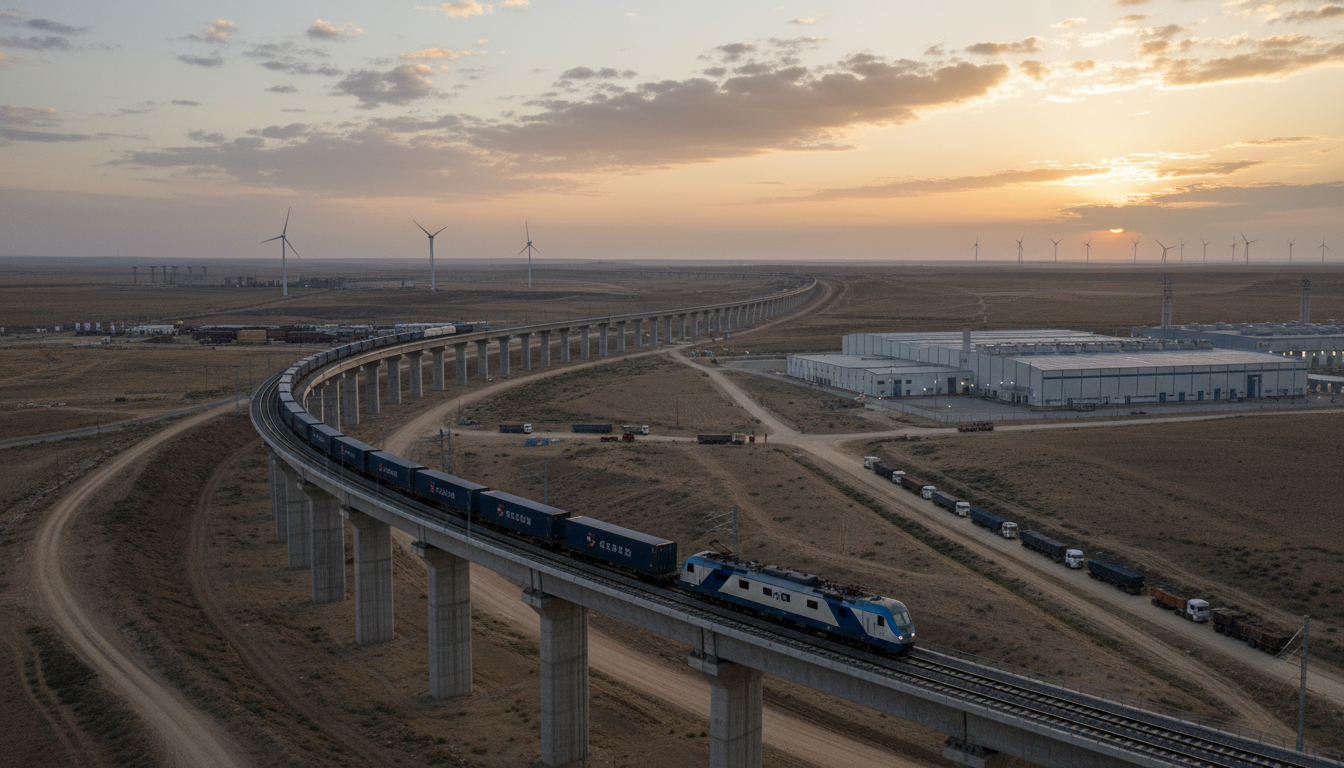
China's engagement with Central Asia has deepened considerably over the past two decades, manifesting in substantial economic, political, and infrastructure investments. This sustained interest has transformed China into an increasingly pivotal diplomatic and trade partner for a region navigating complex developmental pathways.
Beijing's investment strategy extends beyond traditional sectors, now encompassing advanced industries like electric vehicle production, waste processing, and manufacturing. Significant capital is also flowing into renewable energy projects and mining, reflecting a broad-based approach to regional economic integration.
Formalised high-level political engagement underscores this expanding relationship, notably exemplified by the 2023 China-Central Asia Summit in Xi'an. This gathering brought together Chinese President Xi Jinping and leaders from all five Central Asian states, solidifying strategic dialogue and cooperation frameworks.
Analysts such as Elzbieta Pron, whose research focuses on China-Central Asian relations through the Shanghai Cooperation Organisation and Belt and Road Initiative, offer critical insights into Beijing's evolving regional role. Her work highlights the strategic rationale underpinning China's considerable outreach.
Central Asia has frequently served as a strategic "testing ground" for diverse Chinese initiatives and grander projects, according to expert analysis. The region's unique geopolitical attributes allow China to refine approaches before deploying them more broadly across other international theatres.
Geographical proximity to Central Asia facilitates tangible initiatives such as security cooperation and transportation networks. Yet, its distinct political, cultural, and ethnic landscape presents a nuanced diplomatic challenge, serving as a proving ground for Beijing's adaptability.
Central Asian perspectives towards China’s economic presence shifted markedly between the 1990s and 2013, evolving from initial reluctance to a more welcoming stance. This change reflected a re-evaluation of regional priorities and external strategic alignments.
A decisive factor in this policy recalibration was the establishment of the Russian Customs Union in 2010, which was later institutionalised as the Eurasian Economic Union in 2015. This development significantly altered the regional trade landscape and economic calculus for Central Asian states.
While the EAEU facilitated market access to Russia and streamlined internal trade, it simultaneously complicated trade relations with China, effectively binding the Central Asian region more tightly to Moscow. This outcome ran counter to the stated foreign and economic policy goals of "opening up" in all directions.
In this context, China’s expansive global infrastructure and connectivity projects, particularly the Belt and Road Initiative, emerged as a timely and perfectly aligned solution. The BRI offered an alternative vector for economic engagement and reduced reliance on a singular economic partner.
Most Central Asian governments, excluding Kyrgyzstan, offered ideal partners for Beijing due to their predictable, stable, and long-term authoritarian governance structures. This political stability allowed for the confident development of large, costly, and frequently protracted infrastructure projects.
Despite relatively widespread Sinophobic sentiments within the region’s populace, these popular voices have had demonstrably limited impact on foreign policy-making between Central Asian governments and China. This detachment enabled state-level strategic cooperation to proceed largely unhindered.
Furthermore, the unique geographical features of Central Asia, especially Kazakhstan, presented compelling advantages for China’s infrastructure ambitions. Kazakhstan’s extensive shared border with China’s most urbanised regions proved particularly attractive for developing critical connectivity.