There is a line in the Kremlin’s pre-visit briefing that I keep returning to. Yuri Ushakov, the presidential aide who has been staging these productions for longer than most Central Asian presidents have been in office, explained to reporters why Vladimir Putin was making a second state visit to Kazakhstan in the same presidential term — something that simply isn’t done, by convention. The answer: “at the suggestion of our Kazakh friends.”
Our Kazakh friends suggested it. Kazakhstan asked Russia to come. The host invited himself, at the guest’s insistence. This is the grammar of the relationship, and no amount of signed documents will change it.
———
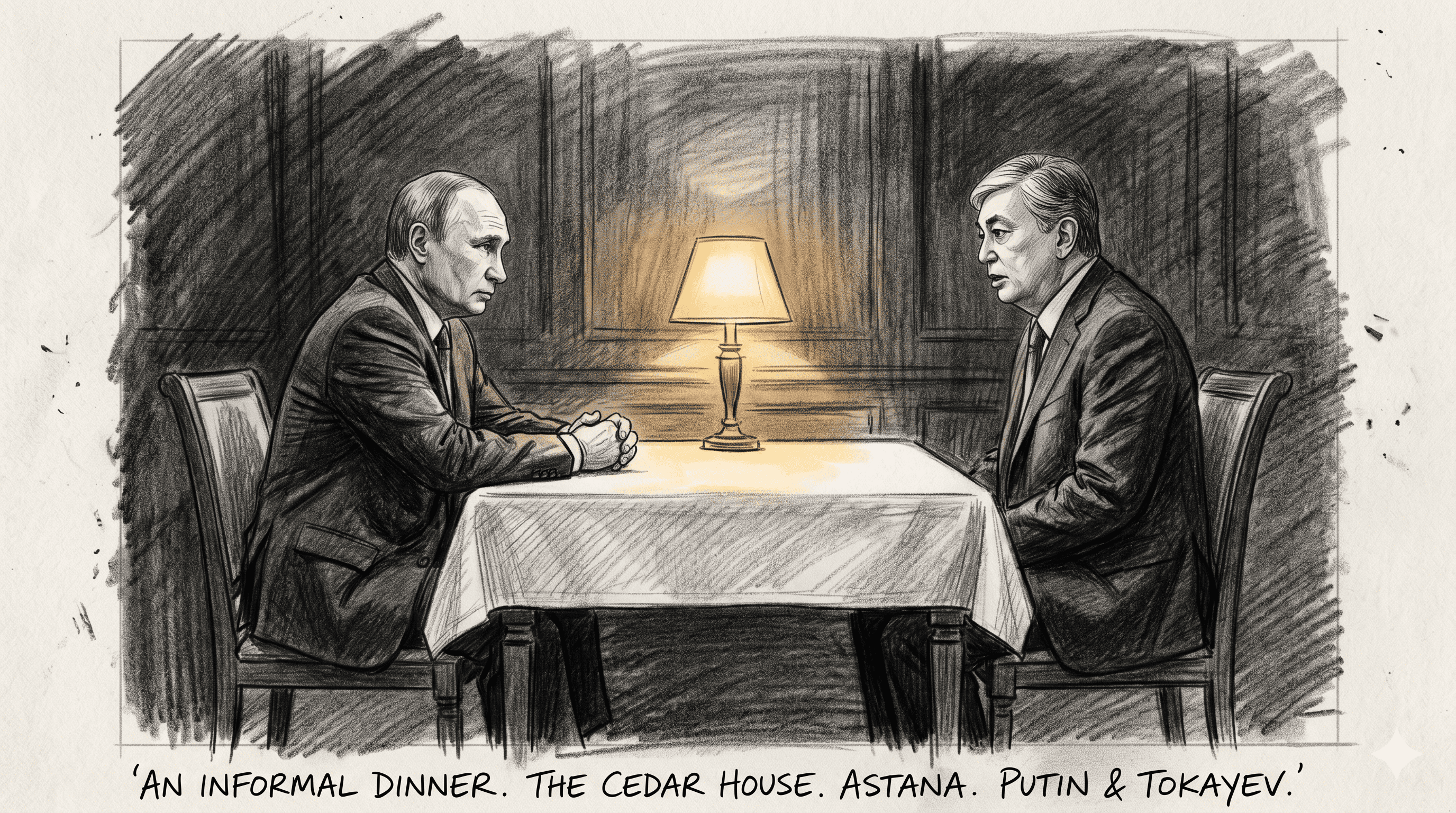
The visit had the full ceremonial apparatus. A guard of honour. Aircraft trailing the Russian tricolour over Astana’s sky. An informal dinner at the presidential residence — the Cedar House, which sounds like somewhere you might go for a spa retreat — where Putin and Tokayev sat alone and, according to Ushakov, “undoubtedly discussed Ukraine in detail.” Undoubtedly. We are not told what was said. We are told only that it was undoubtedly discussed, which is the diplomatic equivalent of a closed door with the light on inside.
Sixteen documents were signed on 28 May. One of them was a joint statement on the “seven foundations of friendship between the peoples of Russia and Kazakhstan.” Seven foundations. Not five, not ten — seven, which suggests someone sat down and counted. Among them, as far as can be determined from what was released: cooperation in energy, finance, healthcare and education. The tigers.
Yes, the tigers. Putin mentioned the restoration of the Amur tiger population as an example of successful environmental cooperation between Russia and Kazakhstan.
I do not know how many Amur tigers there are in Kazakhstan. But I am certain that their appearance in a press statement — held in the shadow of an ongoing war, a sanctions regime, and a historic EAEU discussion about a member state’s departure — says something profound about the art of finding common ground.
———
Tokayev, for his part, said something genuinely interesting — interesting enough that the Russian media apparently decided to bury it. He told Putin, at their joint press statement, that the Russian leader was carrying out “a mission of crucial importance for the Russian people and the Russian state.” A Russian-language commentary outfit called this out within hours: Tokayev said “Russian people,” but Russian outlets quietly substituted synonyms in their coverage. “Russians” became “citizens,” or “the state,” or some other formulation that removed the ethnic specificity.
Why? Because “a mission of crucial importance for the Russian people” reads one way to a Russian audience, and rather differently to a Kazakh one — a country where roughly a third of the population is ethnically Russian, and where the relationship between Kazakhstani national identity and Russian ethnic nationalism is, to put it gently, a live question.
Tokayev knew exactly what he was saying. Whether he meant it as a gift to Moscow or a careful formulation designed to satisfy without fully committing is, of course, unknowable. This is the thing about Tokayev: he is a very precise man. His imprecisions are usually deliberate.
———
Meanwhile, in a briefing across town, Ushakov was asked about Ukraine — specifically, whether Putin had sent any message to Donald Trump regarding potential Russian strikes on Kyiv’s defence industry. The answer was no. No message to Trump. The Russian Federation had sent a recommendation “through appropriate channels” regarding the strikes, but there had been no response. And regarding the broader peace process — the discussion of who should negotiate and on whose behalf — Ushakov offered the most revealing remark of the entire visit:
“Well, let them sort it out.”
“Well, let them sort it out.” Delivered from Astana. From a state visit emphasising the “unprecedentedly high level” of the Russia-Kazakhstan relationship. While signing seven foundations of friendship and discussing Amur tigers. This is either supreme confidence or supreme exhaustion; I have been watching this part of the world long enough to believe it might be both.
———
There is one more detail worth sitting with. Among the sixteen documents signed was an agreement on the principles of cooperation for the construction of a nuclear power plant in Kazakhstan. Putin described it as creating “an entire industry” in the republic, involving not just construction but personnel training. This is true, and this is important, and this is also something that the Western partners currently courting Kazakhstan — with critical minerals deals and EBRD financing and uranium diversification frameworks — would do well to read carefully.
The nuclear plant agreement is the document that actually matters most. Everything else — the tigers, the seven foundations, the friendly lunch, the undoubted Ukraine discussion — is atmospherics. The reactor is the relationship.
Kazakhstan needs electricity. Russia builds reactors. The West wants Kazakhstan’s uranium and would prefer it not also host Russian nuclear infrastructure. Tokayev, who is a very precise man, signed all sixteen documents and said all the correct things at the joint press statement, and then his Kazakh friends went ahead and invited Putin to come back again, unprecedented protocol be damned.
“Well, let them sort it out.”
Peter Lidovsky writes on Eurasia and the politics of the spaces between empires. He contributes a weekly column to Central Asia Wire. The views expressed are his own.