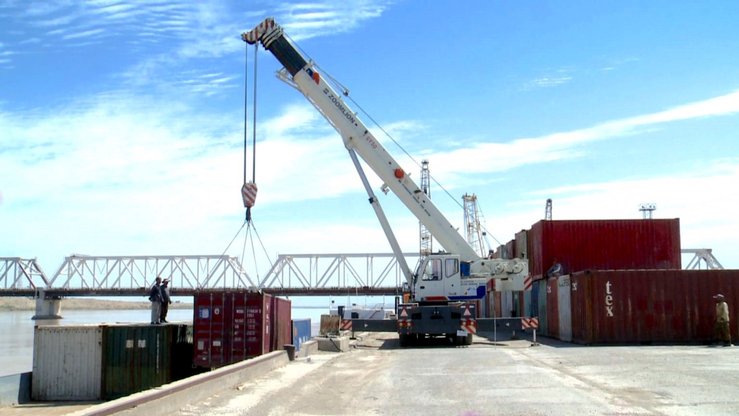
A new dry port terminal — designated Railway Port No. 5 — was inaugurated on the Hairatan–Mazar-i-Sharif railway in northern Afghanistan on 21 May, with an Uzbek delegation present for the ceremony. The facility, constructed and restored by Sogdiana Trans, a subsidiary of Uzbekistan Railways, received its first freight train during the inauguration and immediately began cargo unloading operations.
The Uzbek side was represented by Zufar Narzullayev, Chairman of Uzbekistan Railways, who held parallel talks with Mullah Abdul Ghani Baradar, Afghanistan's Deputy Prime Minister for Economic Affairs. The discussions focused on increasing the line's carrying capacity and accelerating further infrastructure upgrades — including a proposed 1.65-kilometre branch line near Naibabad station designed to reduce wagon waiting times.
Uzbek and Afghan representatives said the facility is expected to increase freight volumes and improve logistics efficiency along the Hairatan–Mazar-i-Sharif line.
Why this corridor matters beyond bilateral trade
The Hairatan–Mazar-i-Sharif railway — 75 kilometres of single-track, 1,520mm gauge line completed in 2010 with Asian Development Bank financing — is Afghanistan's primary northern rail link. It carries fuel, food, construction materials and humanitarian cargo, and functions as the main physical connection between Afghanistan's northern economic centres and the Central Asian rail network.
For Uzbekistan, the line is a component of a much larger ambition: the Trans-Afghan Railway (UAP), a proposed corridor linking Uzbekistan through Afghanistan to Pakistani ports on the Arabian Sea. That project — formalised in July 2025 — would give Central Asian exporters their first direct rail access to the Indian Ocean, reducing dependence on Russian, Chinese and Iranian transit infrastructure. Tashkent has been in active talks with Islamabad, and the first cargo delivery through the Pakistan–Iran–Central Asia transit route under Pakistan's April 2026 Transit Order has already been tested.
The opening of Port No. 5 is a tactical increment in that strategic build-out. It increases throughput capacity on the Hairatan line — a bottleneck that would need to be resolved before higher UAP volumes become feasible. The Taliban, for their part, have been cooperative on the rail corridor: earlier this month, Afghanistan allocated 1,000 acres near Hairatan for a special economic zone aimed at Uzbek investors, suggesting the economic logic of the corridor is aligning interests that otherwise have little in common.
Critically, the corridor runs through territory where the Pakistan–Afghanistan military confrontation — ongoing since February 2026 — has created instability further south. The northern Afghan corridor is physically removed from the Torkham and Chaman crossing points that Islamabad closed, giving the Hairatan route added significance as the only reliably operational Central Asia–Afghanistan link.