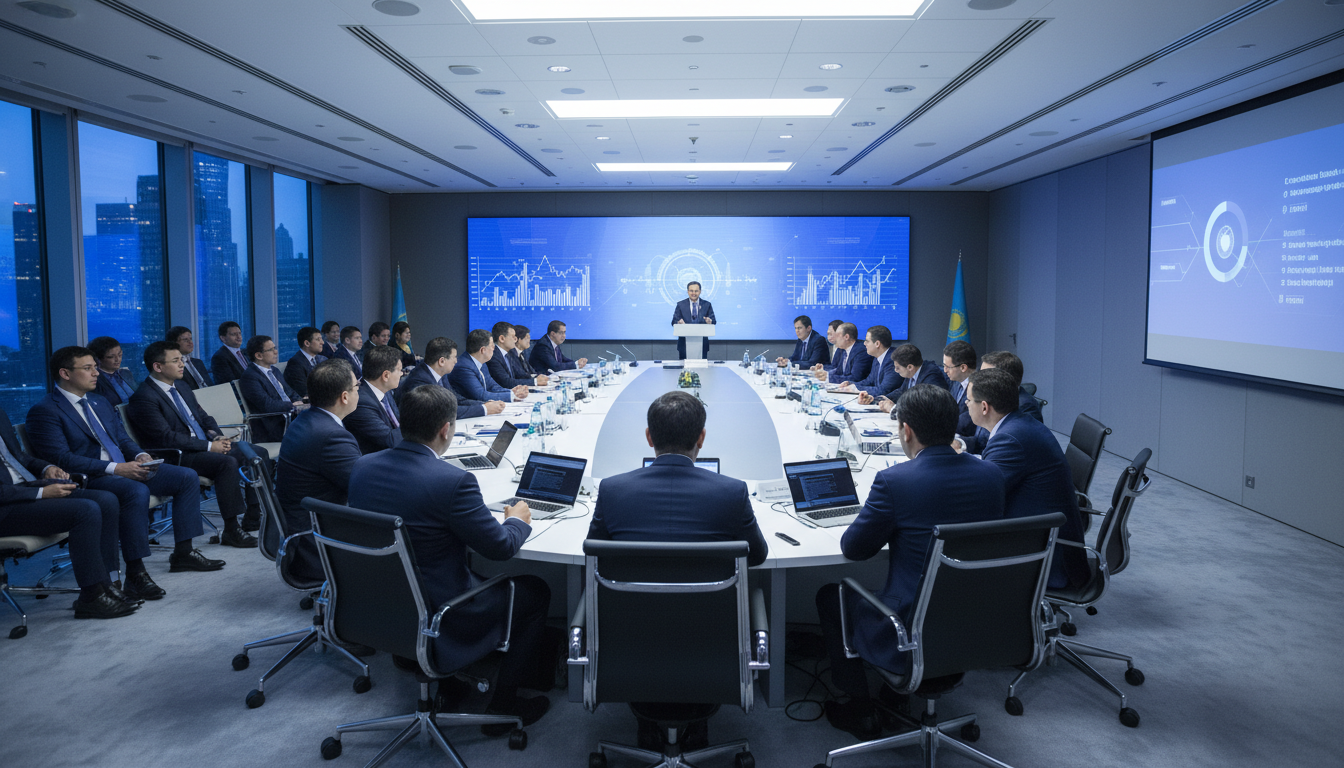
Kazakhstan’s recent Finance Day in New York offered a masterclass in sophisticated economic diplomacy, unfolding at Citigroup headquarters for a third successive time. High-level officials and executives presented a compelling narrative of a nation poised for a new phase of market development, directly engaging U.S. investors. This sustained dialogue underscores Astana’s commitment to its global financial integration.
Timur Suleimenov, governor of the National Bank, provided a reassuring macroeconomic picture, citing robust 6.5% economic growth in 2025 and easing inflation to 11%, with a firm commitment to reaching the 5% target. His presentation underscored the government’s focus on tighter macroeconomic coordination, fiscal discipline, and extensive financial-sector development. Such stability forms a critical bedrock for long-term capital deployment.
Suleimenov further articulated Kazakhstan’s strategic shift away from structural dependence on oil revenues, highlighting a proactive agenda of legal and tax changes designed to significantly improve the investment climate. This represents a conscious effort to broaden the economic base, moving towards more sustainable and diversified growth engines. It signals a maturation of policy intent, aligning with global economic resilience trends.
Intriguingly, the National Bank governor revealed plans for a national crypto reserve framework, envisioning the gradual accumulation and management of digital assets within the sovereign reserve diversification strategy. This ambitious move, alongside continued work on the digital tenge and national digital financial infrastructure, positions Kazakhstan at the forefront of financial innovation. Such initiatives could attract digitally-focused investors.
Geopolitically, Suleimenov framed the Middle Corridor as an increasingly vital artery, describing the route through Kazakhstan, the Caspian, and the Caucasus as “the only viable, reliable route” between East and West. This bold claim positions Kazakhstan as an indispensable linchpin in global trade, leveraging its strategic geography for economic advantage. We recognise this as a direct appeal to investors seeking connectivity amidst geopolitical flux.
Aidar Ryskulov of Samruk-Kazyna detailed the sovereign wealth fund’s significant financial heft, boasting $88 billion in assets under management and a healthy $10.8 billion in EBITDA. He confirmed the fund's intention to remain active in international debt markets and pursue a public market transaction this year, considering London, Hong Kong, and Astana. This signals a confident approach to capital raising and greater transparency.
Ryskulov specifically pointed to ambitious IPO plans for Kazakhstan Temir Zholy (KTZ), the national railway company, aiming to double its 55 million-ton capacity within five to seven years. He also highlighted Kazatomprom, the state uranium producer, as an undervalued "best asset" with high-dividend potential. These planned offerings represent substantial opportunities for global institutional investors.
Zhandos Shaikhy illuminated Baiterek National Managing Holding's extensive reach, managing over $36 billion of assets across diverse sectors and having extended over $20 billion in financing support last year. Critically, Baiterek is advancing 28 national-scale projects spanning energy, mining, petrochemicals, logistics, data centres, and rare earth minerals. This broad pipeline suggests a comprehensive national development strategy.
Bayan Konirbayev, representing the Alatau City Authority, highlighted infrastructure plans tied to the new urban development, hinting at Kazakhstan’s aspirations for creating a modern, digitally integrated smart city. While details were brief, the inclusion signals a commitment to urbanisation and technological advancement, potentially drawing significant foreign direct investment into real estate and smart technologies.
Ambassador Magzhan Ilyassov contextualised the event within strengthening US-Kazakh economic ties, referencing over $17 billion in commercial agreements signed during President Tokayev’s November 2025 visit to Washington, with further agreements under consideration. This underscores a robust diplomatic effort to translate political goodwill into tangible economic partnerships. The recurring presence at Citigroup headquarters reinforces this mutual engagement.
Kazakhstan’s Finance Day delivered a coherent and highly professional pitch, showcasing a nation diligently working to diversify its economy, improve its investment climate, and leverage its strategic geographic position. The detailed presentations from key financial and economic players painted a picture of a stable, reform-minded state actively seeking global capital and expertise. We perceive this as a significant step in its international outreach.
Despite the impressive presentation, the true measure of Kazakhstan’s success will lie in the consistent implementation of these ambitious reforms and project pipelines. Attracting and retaining foreign investment in a volatile global landscape requires sustained commitment, transparency, and resilience to regional challenges. The coming years will reveal whether these bold pronouncements translate into enduring economic transformation.