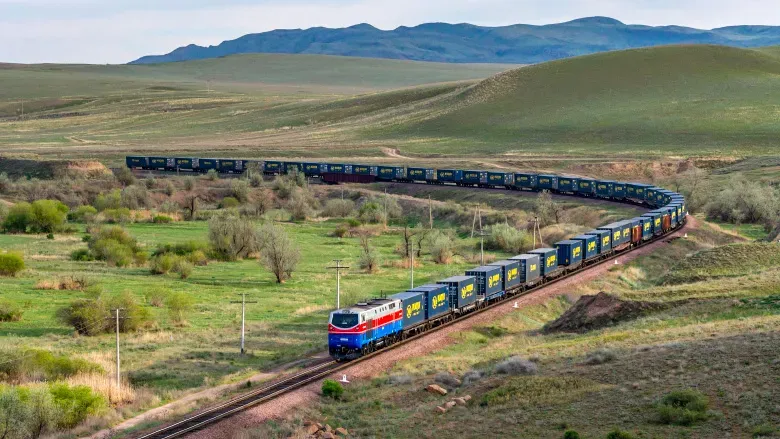
Kazakhstan's state railway operator Kazakhstan Temir Zholy has announced plans for a triple-listed IPO this year on the London Stock Exchange, the Hong Kong Stock Exchange and a domestic Kazakh exchange. The announcement came on 23 May from Samruk-Kazyna, the sovereign wealth fund that owns KTZ, confirming a timeline set by a government resolution last October.
The timing and the choice of listing venues say something deliberate about who KTZ is trying to attract. London offers access to European institutional capital; Hong Kong brings in Chinese investors who are already stakeholders in Middle Corridor growth; the domestic listing signals commitment to Kazakh retail and sovereign participation. The company is pitching itself as the essential infrastructure play on one of Eurasia's most-discussed trade routes.
The IPO may be viewed both as a transit-growth story and as a way to ease pressure on the balance sheet of a state-owned operator with large capital needs.
The corridor case — and its complications
KTZ's investment thesis centres on the Trans-Caspian International Transport Route, the overland corridor linking China and Europe via Kazakhstan, the Caspian Sea, Azerbaijan, Georgia and Turkey. Since Russia's invasion of Ukraine in 2022, freight volumes on the route have grown as shippers and governments sought alternatives to the Northern Corridor through Russian territory. That growth story is real.
But so is the debt. KTZ's obligations have risen sharply — from around $5.7 billion in early 2024 to approximately $10.4 billion by April 2026 — as the company borrowed heavily to modernise rolling stock, build new sections of track, and expand Caspian port capacity. In February, the World Bank approved an $846 million guarantee to mobilise $1.41 billion in long-term commercial financing for a new 322-kilometre rail shortcut between Mointy and Kyzylzhar, designed to cut transit times and eliminate a major network bottleneck.
To improve the company's financial profile ahead of the listing, KTZ doubled tariffs for coal, grain and iron ore shipments in April 2026 — a move that reduces losses on socially mandated freight but adds to costs throughout Kazakhstan's supply chain. The Supreme Audit Chamber had flagged financial sustainability risks as early as 2024.
What to watch
The IPO prospectus will show investors — for the first time in detail — the financial structure of Central Asia's largest railway operator. Watch for: the proportion of Middle Corridor revenue versus domestic freight; the terms of the World Bank and AIIB guarantees; and whether Chinese institutional investors take a significant stake, which would mark a further deepening of China's stake in the corridor's infrastructure.