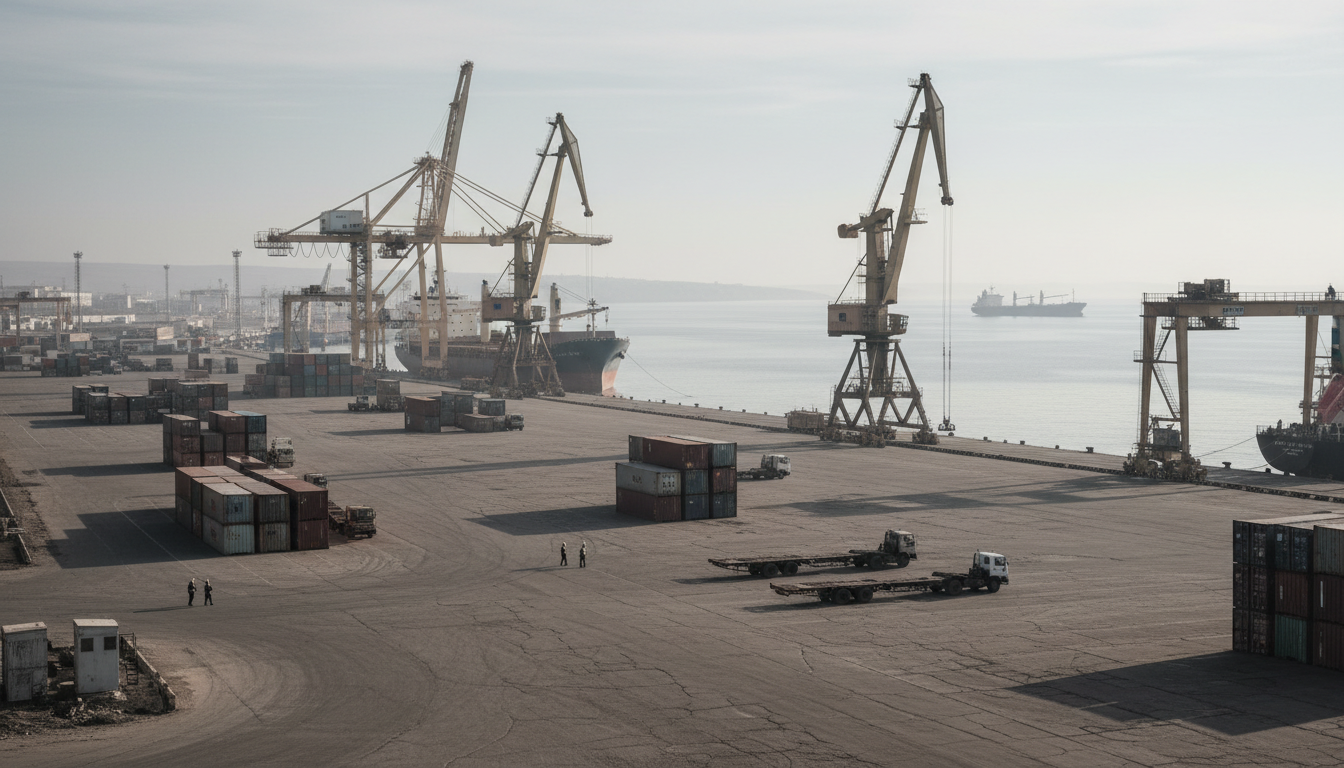
Kazakhstan’s foreign trade in 2025 demonstrated continued expansion in overall turnover, yet underlying shifts in export revenues and import growth presented a more complex picture for the Central Asian nation. While trade remained a crucial economic driver, a significant narrowing of the trade surplus indicated rising structural risks and increased pressure on the external sector.
The trajectory of Kazakhstan’s trade balance reflects an economy grappling with global market dynamics and the imperative for diversification. Policymakers are now confronted with the challenge of maintaining robust economic growth while addressing fundamental imbalances that could impact long-term stability.
Overall Trade Dynamics
Kazakhstan's foreign trade turnover reached $143.9 billion in 2025, marking a modest 1.3% increase compared to the previous year. This expansion, however, concealed a divergence between export and import performances.
Exports experienced a 3.2% decline, settling at $79 billion, while imports surged by 7.4% to $64.8 billion. This disparity led to a significant contraction of the trade surplus, which narrowed from $21.3 billion to $14.2 billion.
The trade surplus as a percentage of GDP consequently decreased from 7.3% in 2024 to 4.6% in 2025. Despite these challenges to the external balance, trade continued to play a central role, contributing 26% to the nation’s total GDP growth.
Domestic trade turnover reached 80 trillion tenge, approximately $168 billion, complemented by 1.3 trillion tenge ($2.7 billion) invested in the sector. Non-resource exports, a key diversification target, stood at $41 billion, alongside a 3.7% growth in services exports to $12.3 billion.
Evolving Trade Partnerships
Kazakhstan’s trade relationships in 2025 remained concentrated among key partners, albeit with shifting dynamics. China and Russia continued as the largest trading partners, with trade growth with China primarily propelled by imports.
Trade with European countries largely hinged on commodity exports, underscoring Kazakhstan's resource-dependent export model in this direction. The Netherlands, for instance, was a significant export destination, primarily for crude oil.
Trade with the United States reached $3.2 billion, but Kazakhstan’s exports to the US nearly halved to $1.0 billion, while imports saw only a slight decline to $2.2 billion. Although US tariffs directly affected only a minor portion of exports, broader market uncertainty likely influenced exporter behaviour.
Within the Eurasian Economic Union (EAEU), total trade amounted to $30.9 billion, a marginal decrease of 0.1% year-on-year. Exports to EAEU countries declined by 8.3% to $10.1 billion, while imports increased by 4.4% to $20.8 billion.
Russia remained the dominant EAEU partner, accounting for 88.6% of trade, followed by the Kyrgyz Republic at 7.3%, Belarus at 3.9%, and Armenia at 0.2%. This structure highlights a persistent reliance on Russia within the bloc.
Commodity Dependence and Diversification Challenges
Kazakhstan’s export profile in 2025 remained heavily dominated by a narrow range of commodities. Crude oil and petroleum products constituted the largest share at 50.5%, reinforcing the country’s vulnerability to fluctuations in global energy markets.
Other significant export categories included radioactive chemical elements and isotopes at 5.3%, refined copper and unwrought copper alloys at 5.2%, copper ores and concentrates at 3.6%, and ferroalloys at 2.6%. This composition indicates a limited shift towards higher value-added goods in the export mix.
On the import side, key categories included passenger cars (4.4%), pharmaceuticals (2.8%), telephones (2.4%), motor vehicle bodies (2.3%), and parts and accessories for motor vehicles (2.2%). This reflects significant consumer demand and industrial reliance on foreign-manufactured goods.
Italy (19.8%) and China (19.2%) were Kazakhstan’s main export partners, followed by Russia (10.3%), the Netherlands (7.6%), Türkiye (4.9%), and Uzbekistan (4.5%). Conversely, Russia (29.7%) and China (29.2%) were the principal import partners, with Germany (4.8%), South Korea (3.5%), the United States (3.3%), and France (2.4%) also featuring prominently.
Strategic Policy Responses
The Kazakhstani government acknowledges the need for strategic adjustments to its trade policies. Deputy Prime Minister and Minister of National Economy Serik Zhumangarin stressed the importance of transitioning from a regulatory approach to one that actively drives growth through expanded trade turnover.
Key policy priorities include strengthening domestic supply chains and increasing exports, particularly those with higher value-added content. Initiatives also encompass digitalization of trade processes and the development of exchange-based trade mechanisms.
A significant government plan involves capitalising the Baiterek holding company with one trillion tenge ($2.1 billion). This funding is earmarked for approximately 1,500 projects across agriculture, manufacturing, and infrastructure, many of which aim to reduce the nation's dependence on imports.
Outlook and Structural Risks
The trajectory of Kazakhstan’s foreign trade in 2025 points to a period where external pressures are intensifying. While the economy demonstrated resilience in overall trade volume and continued to leverage trade for GDP growth, the declining export revenues paired with accelerating import growth suggest a structural challenge to the external balance.
The government's focus on diversifying non-resource exports and bolstering domestic production through initiatives like the Baiterek capitalization addresses these imbalances directly. A critical institutional challenge remains ensuring stable demand for the output generated by these new domestic capacities.
Despite efforts towards diversification, the continued reliance on commodity exports and the burgeoning demand for imported finished goods highlight the persistent structural risks. Navigating these dynamics will be crucial for Kazakhstan's economic stability and its strategic positioning within regional and global markets.