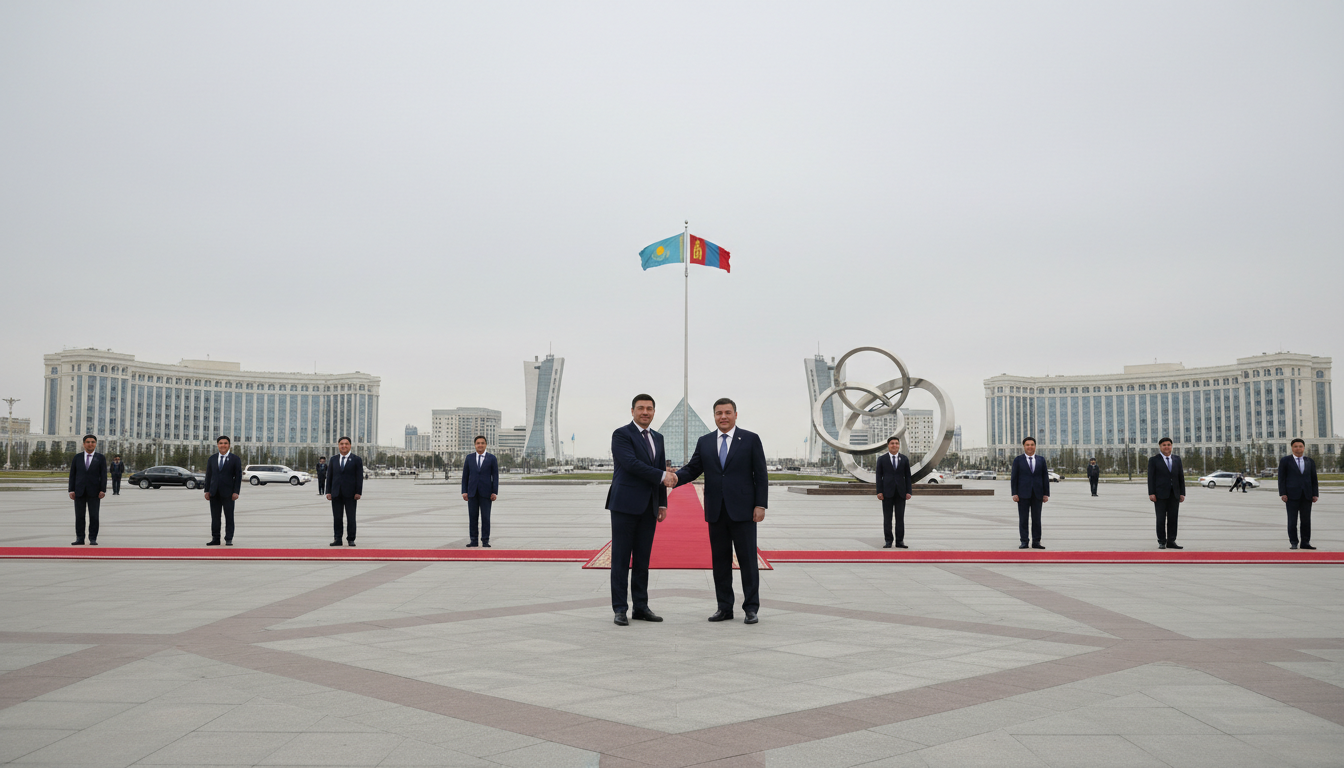
Mongolian President Ukhnaagiin Khurelsukh conducted a state visit to Astana, holding talks with Kazakh President Kassym-Jomart Tokayev on April 21. Discussions centred on significantly enhancing bilateral trade and improving transport links, formalising an elevated strategic partnership between the two landlocked nations. This engagement follows President Tokayev’s own state visit to Mongolia in October 2024, which initially established the current strategic framework.
A central objective emerging from the Astana talks is to increase bilateral trade turnover to $500 million. This represents an ambitious five-fold increase from the current figure, which stood at over $130 million last year, itself a 7.7% annual rise. President Tokayev underscored the strengthening trade and economic cooperation, projecting concrete industrial projects to support this growth trajectory.
Crucial to achieving these trade targets is the proposed expansion of direct connectivity. Both leaders agreed to resume direct flights between Astana and Ulaanbaatar, alongside a route connecting Ust-Kamenogorsk and Ulgii. These air links aim to overcome geographical barriers and facilitate direct interaction.
Further enhancing transport infrastructure, a joint working group will be established to explore direct road connections between Kazakhstan and Mongolia. Such initiatives are fundamental for landlocked states seeking to diversify their trade routes and reduce reliance on established corridors through larger neighbours. Improved road infrastructure offers vital logistical advantages for goods movement.
This renewed focus on connectivity positions both nations more centrally within broader trans-Eurasian transport networks. By strengthening East-West and North-South links, Kazakhstan and Mongolia can enhance their roles as transit countries, fostering greater economic integration across the continent. Such developments offer alternatives to existing routes.
Cooperation extends across multiple economic sectors, including agriculture, light industry, and mining, where both countries possess substantial natural resources. Digitalisation, tourism, and logistics were also identified as areas for joint development, aiming to modernise economies and create new revenue streams beyond traditional sectors.
The state visit culminated in the signing of 13 agreements and memorandums, covering a comprehensive array of bilateral cooperation fields. These documents address foreign policy coordination, trade and economic ties, energy, finance, and the peaceful use of nuclear energy, signifying a broad commitment to deepen relations.
Institutional partnerships were also formalised, with agreements between national entities such as Samruk Kazyna and Erdenes Mongol, alongside central banks and national academies of sciences. These collaborations provide a robust framework for state-backed investment and academic exchange, strengthening the operational aspects of the strategic partnership.
Beyond economic and infrastructure initiatives, the agreements include expanded cultural, scientific, and media cooperation, outlined in a joint action plan for 2026–2027. Such measures aim to foster closer people-to-people ties and mutual understanding, complementing the strategic economic agenda.
Kazakhstan has also committed to bolstering its educational support for Mongolia, including an increase in annual scholarships for Mongolian citizens. Plans include hosting a "Study in Kazakhstan" education fair in Mongolia and exploring the establishment of a branch of a leading Kazakh university in Ulaanbaatar, strengthening academic ties.
Furthermore, Kazakhstan expressed gratitude for Mongolia’s support in opening a Kazakh consular office in the Bayan-Ölgii region, a critical step for enhancing interregional ties. Memorandums between city administrations were also signed, demonstrating a commitment to localised cooperation and cross-border engagement.
President Khurelsukh underscored that Kazakhstan is the first Central Asian nation with which Mongolia has forged a strategic partnership. He reiterated that strengthening friendly relations and expanding trade are central to Mongolia's foreign policy priorities, highlighting the mutual importance of this evolving relationship.
This comprehensive engagement between Astana and Ulaanbaatar represents a strategic move for both nations, seeking to diversify international partnerships and enhance regional resilience. The partnership offers a platform for economic growth and geopolitical balancing within a complex Eurasian landscape.